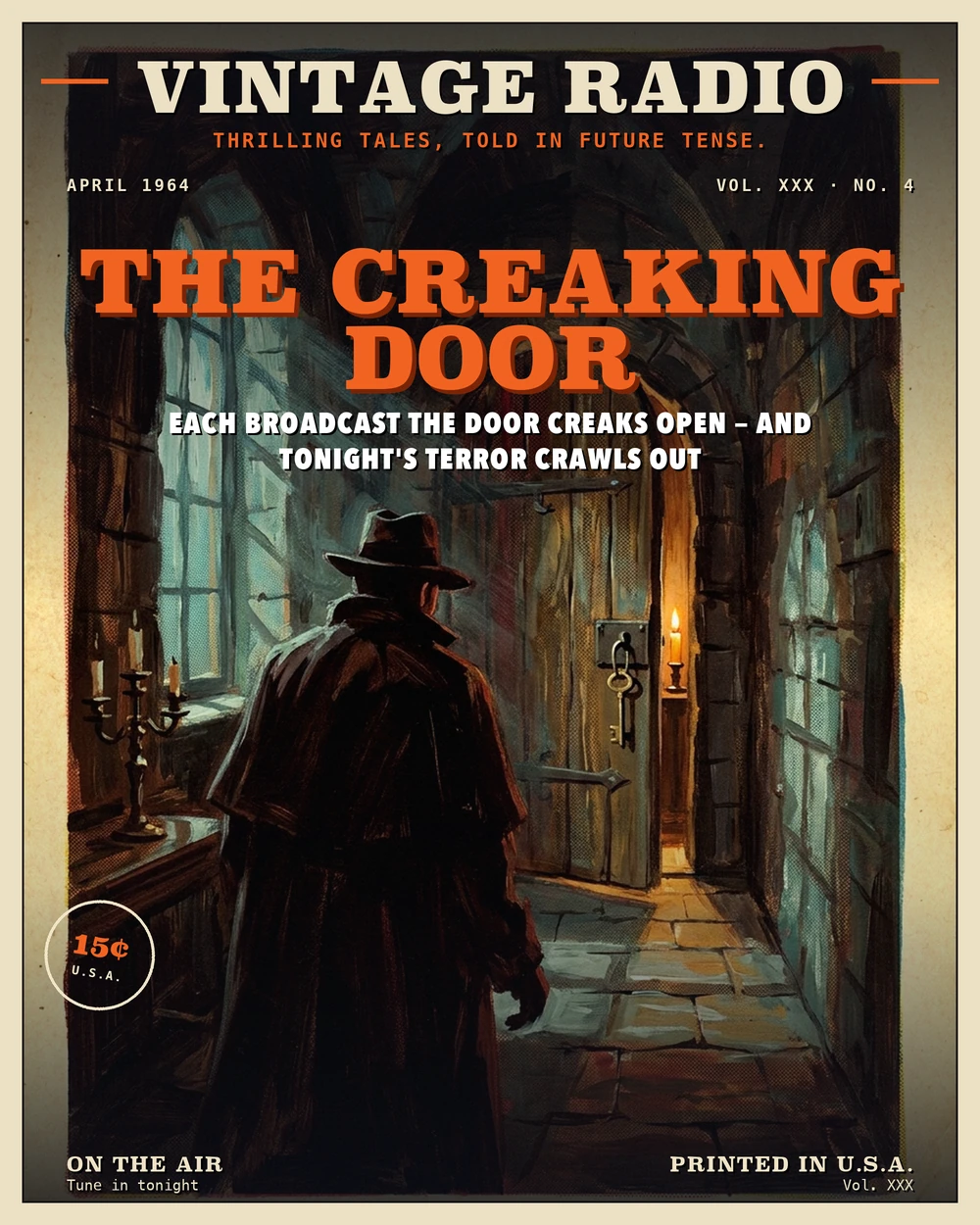
The Creaking Door
Where It Came From
Most old-time radio horror came out of New York or Los Angeles. The Creaking Door came from Johannesburg. That alone sets it apart from nearly everything else in the anthology horror catalog. The series aired on Springbok Radio, South Africa's first commercial station, which operated as the SABC's commercial service from 1950 until its closure on December 31, 1985. The show ran from 1964 to 1969, squarely in the middle of Springbok's golden years, and it became one of the station's signature programs alongside other horror and science-fiction productions like Beyond Midnight, SF'68, and Suspense.
The show's roots connect, at least in spirit, to American radio. The Wikipedia article on Springbok Radio describes The Creaking Door as "based on the long running American radio series The Inner Sanctum Mysteries," and the resemblance is deliberate. There's even a pre-history worth tracing: in 1952, Australian radio began recording Inner Sanctum scripts under that show's name, using host Moray Powell. After a fee dispute ended that arrangement, the Australian version was renamed The Creaking Door in 1958, with new scripts by Australian writers. The South African production that began in 1964 is a separate thing entirely — its own production team, its own original scripts, its own voice. That distinction matters.
The Sound That Named the Show
Every episode opened the same way: a door, audibly groaning on its hinges, and then the host's invitation — "the creaking door is opening, so do come in." It's a simple device, and it worked. The creak set the mood before a word of the story had been spoken, and it became the show's signature as much as any character or plot.
Host Peter Bloomfield delivered that invitation and narrated each episode with what Radio Horror Hosts described as a voice "dripping with sinister sarcasm." That's a different register from the winking, pun-heavy approach of Raymond on Inner Sanctum. Bloomfield played it darker, more sardonic, leaning into the dread rather than deflating it with a joke. His presence gave the show a consistent tone that the anthology format sometimes struggles to maintain — each story was different, but the host held the frame.
Producer Michael Silver kept the production values high. Eerie music and carefully placed sound effects did the work that sets and costumes do in other media — suggesting a haunted house, a locked room, a place where something terrible was about to happen. The opening creak wasn't just a trademark; it was a demonstration of what the show did well.
What the Writers Were After
All the scripts in the South African series were originals — no adaptations of Poe or Wilde or M.R. James. Alastair Scobie was among the writers contributing to the series, and the subject matter they worked with was broad. Episode topics ranged from haunted houses to zombie witch doctors to what Radio Horror Hosts, citing Grams, called "the typical paranoid murderer." That last category shows up often. The show had a moralistic spine: killers were frequently "haunted by guilt and often betrayed by fate," which gave even the more outlandish supernatural stories a consistent ethical shape.
The twist ending was a standard tool. Listeners came to expect a reversal or revelation in the final minutes, and the writers delivered it reliably. Combined with recurring themes of vengeance, madness, and isolation, the episode structure was disciplined — these weren't shaggy ghost stories but tightly constructed half-hours designed to land a punch.
One episode, "Face to Face," offers an accidental timestamp. The story concerns a planned first Moon landing and refers to "Cape Kennedy" as the launch site — a name that was only in use between 1964, when Cape Canaveral was renamed, and 1969, when the actual landing happened. That single detail brackets the episode's broadcast date within the show's full run, and it illustrates how contemporary the writers were willing to be. This wasn't a show retreating into Victorian fog and gaslight; it was willing to look at the present day and find the horror there.
The Sponsor and the Station
State Express 555 cigarettes — a British American Tobacco brand, pronounced "State Express Three Fives" in the show's sponsorship — backed the series for many of its years on Springbok Radio. Cigarette sponsorship of anthology drama was common in the period, and State Express's backing helped sustain the show's production quality through its five-year run.
When Springbok Radio closed at the end of 1985, sixteen years after The Creaking Door finished its original run, the recordings were at risk. The Springbok Radio Preservation Society, formed in 2002, archived material from the station, and in 2012 those archives were handed to the SABC Sound Archive. That handover is why any episodes survive at all. The episode count in circulation varies depending on the source — figures range from 34 to 42 extant recordings — and the total number originally broadcast hasn't been definitively established. The catalog here holds 38 episodes.
The Episodes Themselves
The catalog's 38 episodes give a good cross-section of what the show was doing. Titles like "Room for the Night," "Blood Sisters," "Isle of Lost Souls," and "Death in Your Hands" wear the genre's conventions openly. Others, like "Aunt May," "Ever Loving Doll," and "Anna," suggest a quieter, more domestic dread — the kind where the horror turns out to be closer to home than anyone expected. "Inn Spectre" is a title that can't have been accidental, and "The Cards" puts fate in the hands of something inanimate and inescapable.
The range matters. The Creaking Door could do bog-standard supernatural menace when the script called for it, but it could also work smaller stories — a family secret, a grudge that won't stay buried, a character whose guilt finally catches up. That flexibility is probably part of why the show built the audience it did — not a derivative of its American inspiration but something that earned its own place as a unique, well-produced, engaging supernatural thriller series.
Why It Holds Up
The Creaking Door could have been a footnote — a regional production on a now-defunct commercial station, modeled on an American format, running for five years and then going quiet. What keeps it from being a footnote is the quality of the work. The scripts were original, the performances were strong, the production was careful, and the host gave the whole enterprise a distinctive voice. Those things add up.
The fact that it came out of South Africa rather than New York doesn't diminish it — if anything, it adds something. The writers brought their own idiom to the anthology horror form, their own preoccupations with guilt and fate, their own monsters. The show is worth hearing as a piece of horror radio that developed independently, took the genre seriously, and left behind a body of work that survived long enough to be worth hearing now.